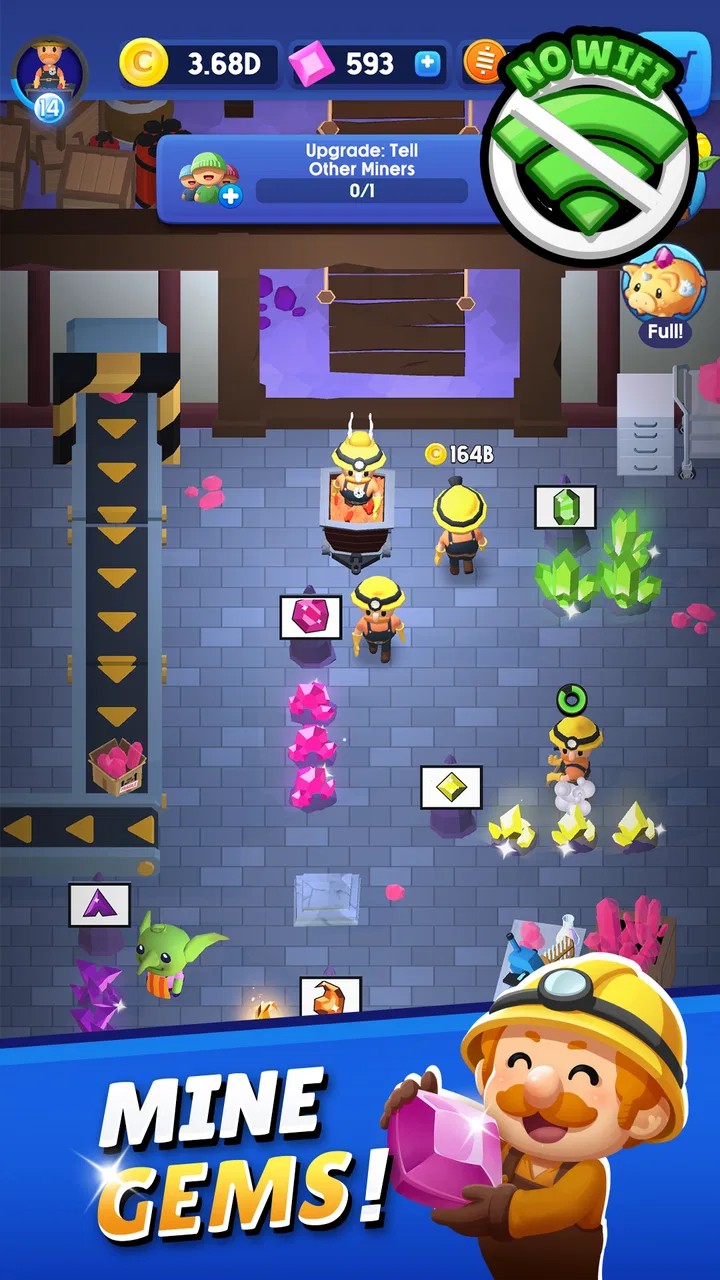
Idle Mine! Tycoon Mining Game
- 4.7
- Rating
- 1.00M
- Installs
- Free
- Price

 Analysis by App-foxy
I approached Idle Mine! Tycoon Mining Game as a quick-play simulation rather than a game that demands constant attention. Its central idea is easy to understand: build a mining business, improve its production, and return to collect progress. That makes it a natural fit for short sessions, but the real question is whether the interface and pace remain comfortable for different abilities and everyday situations.
Developed by Fumb Games, this free game sits in the simulation category and is available for players using an operating system from version 10 onward. It has attracted more than a million installs and holds a 4.7 average from around two thousand ratings, which suggests that its simple mining loop has found a broad audience. I can see why: there is very little setup between opening the game and understanding what to do next.
How comfortable is Idle Mine! Tycoon Mining Game to use?
I find the game’s comfort comes mainly from its low-pressure rhythm: I can make a few considered choices and put my phone away without needing to finish a level. That makes it easier to fit around changing energy or attention than a simulation built on constant management. The next thing to consider is how that relaxed format feels when the routine becomes familiar.
You May Also Like

 Blood Strike: 2.5 Anniversary
Blood Strike’s Loadouts Turn Every Drop Into a Tactical Gamble
A close look at Blood Strike’s custom loadouts: how fast access to signature weapons reshapes its battle royale rhythm, rewards preparation, and narrows the gap between fights.

 Pandora - Music & Podcasts
Pandora’s Music Is Easy to Start, but Harder to Recover
Pandora’s strength is its low-effort path from a seed to a station. Its weak spot is how much confidence it asks you to place in connection, setup, and quiet recovery.

 8 Ball Pool
 Is Built on Rivalries, Rematches, and Routine
A close look at the rivalries, rematches, shared routines, and unanswered safety questions that turn a quick pool match into a persistent mobile community.

 Samsung Music
’s Quiet Strength Is Playing What You Already Own
Its reach comes less from spectacle than from dependable access to a personal library. That simplicity is both the app’s strongest retention engine and its ceiling.

 AccuWeather: Weather Radar
AccuWeather Review: A Quick, Clear Forecast for Everyday Decisions
For everyday plans, the best forecast is the one you can understand quickly. AccuWeather makes rain timing, radar, and local conditions easy to act on, with a few trade-offs.

 Hill Climb Racing
Why Hill Climb Racing Still Turns Crashes Into One More Run
A tiny car, a bumpy hill and one more upgrade: Hill Climb Racing keeps resurfacing because its simple chaos makes every near-miss feel personal.
More From Our News Desk



Readable navigation and a low-learning-curve layout
The strongest accessibility advantage is the straightforward structure. A player does not need to learn a complicated control scheme before making progress. The mining theme gives the main actions a clear context, and the tycoon format naturally encourages a repeated rhythm: check the operation, improve it, and let the business continue developing.
That simplicity matters for people who find dense menus tiring. Someone who is new to idle games can usually understand the purpose of the main screen without studying a manual. I also find this style useful when my attention is divided, because I can return after a break and quickly work out what needs attention.
The trade-off is that simple does not automatically mean perfectly clear. Idle games often place several upgrade, reward, and progression choices close together, and this title is built around that same kind of decision-making. If you have difficulty distinguishing small interface elements or keeping track of several visual prompts, the experience may require more concentration than the relaxed premise suggests.
My practical advice is to avoid tapping through the opening moments too quickly. Spend a little time identifying which controls affect the mine directly and which ones lead to rewards or longer-term improvements. That small pause makes later visits less confusing, especially if you play in short bursts rather than completing a long session.
Motor demands are modest, but repetition still matters
Compared with an action game, this is a gentle choice for players who do not want rapid reactions, precise aiming, or complex combinations of buttons. The mining-tycoon format is much more forgiving than games built around timing. You can approach it at your own pace, which is helpful for players who experience fatigue, tremors, or discomfort with fast touch controls.
Still, the game is not completely hands-off. Progress depends on interacting with the screen, collecting rewards, and choosing improvements. Repeated tapping can become uncomfortable for anyone with hand pain or limited dexterity, particularly during a session focused on maximizing several available actions. I would treat it as a game for light, deliberate interaction rather than assuming it is suitable for every motor limitation.
A useful workflow is to group actions together. Instead of constantly checking the mine, I prefer opening it at natural moments, collecting what is available, and making only the upgrades that support my immediate goal. This reduces unnecessary repeated movement and makes the game feel less demanding without removing the strategic part of the loop.
Players who rely on alternative input methods should be cautious about expectations. The game is designed around ordinary mobile interaction, and I would not choose it specifically for specialized control support. If precise touch targeting is difficult, the lack of a more elaborate control approach could become a deciding barrier.
Visual and sensory comfort in everyday play
The mining setting gives the game a strong visual identity, but visual appeal is not the same as visual accessibility. Players who are sensitive to busy animation, contrast, or frequent reward cues should pay attention to how the screen feels over time. A game that is comfortable for a few minutes may become tiring during a longer optimization session.
I find the idle structure helpful for sensory pacing because it does not force continuous action. You can close the game, take a break, and return later instead of remaining in a constant state of alertness. That makes it more suitable than many fast simulation or management games for relaxed play before a commute, during a break, or while winding down.
On the other hand, the reward-driven nature of the genre can encourage repeated checking. For players who are sensitive to notification-like prompts or who find accumulating tasks stressful, the temptation to keep returning may outweigh the calm pace. The best experience comes from treating the mine as a small routine, not as something that must be monitored every few minutes.
There is also a useful distinction between visual simplicity and cognitive simplicity. The basic objective is easy to grasp, but deciding where to spend resources can still require attention. If you have difficulties with working memory, make one improvement goal at a time. For example, decide that a visit is for increasing production, then postpone unrelated choices until the next check-in. That approach makes the progression easier to follow.
Situational access: where the idle format works best
This is the kind of game I can imagine using in several ordinary situations. On a short break, I can open it, review the mine, make a small decision, and leave without losing the thread. During travel, the same structure works well because the game does not demand a long uninterrupted commitment. It is also suitable for players who prefer games that can be paused simply by putting the phone down.
That flexibility is especially valuable for people whose energy or concentration changes during the day. If you are managing fatigue, the game lets you separate planning from action: one visit can be used to understand your position, while another can be used to make upgrades. You do not have to solve every decision in one sitting.
A realistic example is a player with a busy work or study schedule. They might check the mine before leaving home, return during lunch for a short upgrade session, and make a final visit in the evening. The game fits around those moments better than a level-based title that expects a continuous run. The limitation is that this convenience can turn into a habit of checking too often, so setting a personal schedule is worthwhile.
The free entry point also lowers the risk of trying it. You can see whether the pace suits you before committing money. However, the game includes in-app purchases ranging from less than a dollar to nearly a hundred dollars per item. That range is important for accessibility in the broader sense: a free download is not the same as a completely cost-free experience.
I recommend deciding in advance whether you want to play without spending or whether optional purchases fit your budget. For players who are vulnerable to impulse spending, the purchase range is a genuine reason to be careful. The most comfortable approach is to treat paid items as optional and judge the game by how enjoyable its ordinary progression feels without them.
What the progression feels like for different players
The simulation format is best for people who enjoy gradual growth. You begin with a modest operation and work toward a larger tycoon-style business, so satisfaction comes from watching small decisions accumulate. This is not the right choice if you need a strong story, direct competition, or constant novelty. Its appeal is routine improvement.
I particularly like the way an idle game can reduce the pressure to perform perfectly. A mistake in one upgrade decision does not feel like losing a difficult mission. You can observe the result, adjust your next choice, and continue. That forgiving structure may suit players who become discouraged by failure-heavy games.
There is a downside for players who need immediate feedback. The rewards in a mining simulation are tied to gradual development, and the repeated loop can feel slow if you prefer fast changes. Compared with a conventional management game, there is usually less need for detailed planning; compared with a casual puzzle game, there may be less moment-to-moment variety. Choosing this title means accepting that repetition is part of the design, not an occasional phase.
One of my more useful habits is to separate “progress” from “activity.” An active screen does not necessarily mean a meaningful improvement is available. I get more enjoyment when I check whether a decision genuinely advances the mine instead of tapping every visible option automatically. This also reduces fatigue and helps the game remain a background hobby rather than a demanding obligation.
Remaining barriers and who may want another game
The biggest barrier is the possibility that the interface asks for more visual scanning and repeated touch interaction than some players can comfortably manage. Without assuming that every player will experience the controls in the same way, I would say that people with significant vision, dexterity, or sensory needs should test the opening experience carefully. The free price makes that trial easier, but it does not remove the need to check personal comfort.
The mature age classification is another practical consideration. This game is marked for players aged seventeen and older, so it is not a suitable recommendation for children or younger teenagers simply because the mechanics look casual. Parents should use the age label as part of their decision, especially when considering a shared device.
The purchase system may also be a problem for families, players on strict budgets, or anyone who prefers games with a single transparent payment. A free download can be attractive, but the presence of optional items at very different prices means that spending controls and personal boundaries matter. If you want a completely distraction-free experience with no purchase pressure, a paid game with one upfront cost may be a better alternative.
I would also skip it if you want a simulation with deep construction tools, detailed economic planning, or a large amount of direct control. The idle approach is intentionally lighter. It is closer to maintaining a growing routine than running a fully hands-on industrial operation. Players who enjoy spreadsheets, complex supply chains, and constant strategic intervention may find it too limited.
Conversely, players who find real-time games inaccessible because of speed may appreciate the calmer structure. It is not a guaranteed solution for every access need, but the absence of twitch gameplay removes one important source of pressure. That makes it a more reasonable candidate for relaxed mobile play than many action-focused alternatives.
Version, platform expectations, and choosing the right setup
The current release is version 1.5.1, and the game requires operating system version 10 or newer. Before installing, I would check the software version on the device you plan to use, particularly if it is an older phone or tablet. This is a small step, but it prevents an otherwise avoidable setup problem.
Because the game is designed for mobile sessions, I would also consider the physical context. A larger screen may make visual scanning more comfortable, while a smaller phone can be easier to hold during brief checks. If touch accuracy is a concern, playing when rested and using a stable grip is more sensible than trying to manage upgrades while walking or multitasking.
The title’s broad install base and strong average rating indicate that many players find the basic experience appealing, but neither figure can predict how accessible it will feel to one particular person. I would use the first session as a personal test: can you identify the main action, understand the next improvement, and stop playing without feeling pushed into constant checking?
My inclusive verdict on the mining tycoon
I recommend Idle Mine! Tycoon Mining Game to players who want a free simulation that can be enjoyed in short, flexible visits. Its strongest qualities are the approachable mining premise, the lack of fast action, and the ability to fit progress around an irregular day. Fumb Games has chosen a format that can be easy to pick up even when you do not have the energy for a complicated game.
My recommendation comes with clear limits. Repeated touch actions, visual scanning, reward-driven repetition, and optional purchases may create friction for some players. The mature age rating also means that its casual appearance should not be mistaken for a children’s title. If you need extensive accessibility controls, a deeply detailed management system, or a completely purchase-free environment, another option may serve you better.
For everyone else, I would start with a deliberately modest routine: play for a few minutes, make one or two considered upgrades, and see whether the interface remains comfortable when your attention is not perfect. The best reason to try this game is its flexible pace, not the promise of endless tapping. When approached as a calm, occasional mining check-in, it offers a pleasant alternative to more demanding simulation games and a manageable way to enjoy gradual progress.
FAQs for Idle Mine! Tycoon Mining Game
01What is Idle Mine! Tycoon Mining Game?
Idle Mine! Tycoon Mining Game is an incremental management game in which you build and expand a mining business. You hire workers, improve equipment, unlock deeper underground areas, and collect resources while the mine continues producing even when you are not actively playing. The main objective is to reinvest earnings, increase efficiency, and grow your operation into a profitable mining empire.
02Can I play Idle Mine! Tycoon Mining Game without an internet connection?
The game may allow some idle mining and management features to work offline, but certain functions can depend on an internet connection. Advertising rewards, cloud synchronization, updates, purchases, and other online services may not be available without connectivity. If offline progress is important to you, check the game’s current store description and test which features remain accessible after temporarily disabling your connection.
03Does Idle Mine! Tycoon Mining Game contain advertisements or in-app purchases?
Idle Mine! Tycoon Mining Game is generally designed around optional advertisements and in-app purchases, as is common with free-to-play idle games. Ads may offer bonuses such as extra resources, faster production, or temporary boosts, while purchases can speed up progress or provide premium currency. You can usually play without spending money, although progression may feel slower without optional rewards.
04How does progression work in Idle Mine! Tycoon Mining Game?
Progression is based on upgrading your mining operation and making efficient use of accumulated income. You can typically improve miners, machinery, storage, managers, and production speed while unlocking new mine levels or resource areas. Strategic reinvestment is important because upgrading the right part of the operation can increase earnings more effectively than spending resources randomly.
05Is Idle Mine! Tycoon Mining Game suitable for casual players?
Yes, the game is suitable for casual players who enjoy relaxed management and incremental progression rather than fast reflex-based gameplay. You can make short visits to collect income, activate upgrades, and claim rewards, then leave the mine running. However, players who dislike repetitive upgrade systems, advertisements, or waiting for resources to accumulate may find the experience less appealing over time.
Pros
- Simple idle gameplay works well for short play sessions.
- Offline progress lets your mine continue producing while away.
- Many upgrade paths create a satisfying sense of progression.
- Colorful visuals and clear menus are easy for new players to understand.
- Runs smoothly on most modern Android and iOS devices.
Cons
- Progress can feel slow without watching ads or spending resources.
- Frequent ad offers may interrupt the otherwise relaxed gameplay.
- Limited direct interaction may become repetitive over time.
- Some upgrades require considerable waiting between production cycles.
- Late-game content may lack variety for dedicated players.

Idle Mine! Tycoon Mining Game
Gallery